
Written by Hibt Crypto Research Team
Updated: August 2026
As the RWA and tokenized stock markets evolve, more traditional equities, ETFs, and real-world assets are moving into crypto. In the past, crypto users mainly traded BTC, ETH, DeFi tokens, meme coins, and stablecoins. Today, some platforms are converting US stocks, ETFs, and corporate equity exposures into on-chain assets, allowing investors to participate in traditional financial assets through blockchain.
CRCLON emerges in this trend. When users first search “what is CRCLON,” “CRCLON crypto,” “CRCLON token,” or “CRCLON stock,” the most common questions are: Is CRCLON Circle stock? What’s the difference between CRCLON and CRCL? Is CRCLON a cryptocurrency issued by Circle? How can I invest in CRCLON?
In a nutshell: CRCLON is a tokenized representation of Circle Internet Group designed to provide blockchain-based exposure to Circle’s equity value.
In Chinese terms, CRCLON is a tokenized asset linked to the value of Circle Internet Group stock. It is not a new cryptocurrency issued by Circle itself, but rather a tokenized stock product (via Ondo and similar platforms) that offers on-chain economic exposure to Circle’s equity for eligible investors. According to CoinMarketCap, CRCLon is the Ondo Tokenized version of Circle Internet Group, aiming to deliver economic exposure similar to holding CRCL with dividend reinvestment.
1. What Is CRCLON? Why Is Circle Stock Entering the Crypto Market?
This section answers: What exactly is CRCLON? Is it Circle stock?
CRCLON can be understood as a tokenized stock related to Circle Internet Group – a tokenized equity asset. Its core purpose is not to create a new crypto project but to express the economic exposure of a publicly traded company like Circle through a blockchain-based asset.
- CRCLON is not Bitcoin.
- CRCLON is not Ethereum.
- CRCLON is not a meme token.
- CRCLON is not an official token issued by Circle.
It is closer to an RWA asset – a digital representation of real-world assets in the blockchain market.
Public information shows that Ondo’s CRCLon asset page lists it as “Circle Internet Group CRCLon,” and CoinGecko also categorizes it as “Circle Internet Group Ondo Tokenized Stock” with the ticker CRCLON.
So, for beginners:
- CRCL is Circle’s ticker symbol in traditional stock markets.
- CRCLON is the on-chain tokenized stock asset related to Circle stock.
- CRCLON is not equivalent to directly holding CRCL shares in a traditional brokerage account.
- CRCLON is a form of on-chain asset that provides exposure to the economic performance of Circle stock.
You can check real-time market data via CRCLON Live Price for price, volume, and trends.
2. What Is Circle Internet Group? Why Does It Have Investment Value?
This section explains: If you invest in CRCLON, what company are you really backing?
Circle Internet Group is one of the companies behind the USDC stablecoin and a key player in crypto financial infrastructure. According to Circle’s investor relations, Circle issues USDC and EURC stablecoins through regulated affiliates and is building a widely adopted stablecoin network.
Circle’s core business consists of three main parts:
1. USDC Stablecoin
USDC is one of the most important USD stablecoins in crypto, widely used for trading, payments, DeFi, cross-border transfers, on-chain settlement, and corporate finance.
2. Digital Finance Infrastructure
Beyond stablecoin issuance, Circle is building digital dollar infrastructure for enterprises, developers, and financial institutions. Circle’s 2026 reports mention its platform includes the USDC stablecoin network, Circle Payments Network, and Arc – an enterprise-grade blockchain for internet financial systems.
3. Enterprise-Grade Blockchain Payments and Settlement
The value of stablecoins extends beyond exchange trading to corporate payments, global funds transfer, on-chain settlement, tokenized assets, and programmable finance.
Therefore, investing in CRCLON is not about betting on a generic cryptocurrency – it’s about betting on Circle’s long-term value as a stablecoin and digital finance infrastructure company.
3. Why Tokenize Stocks?
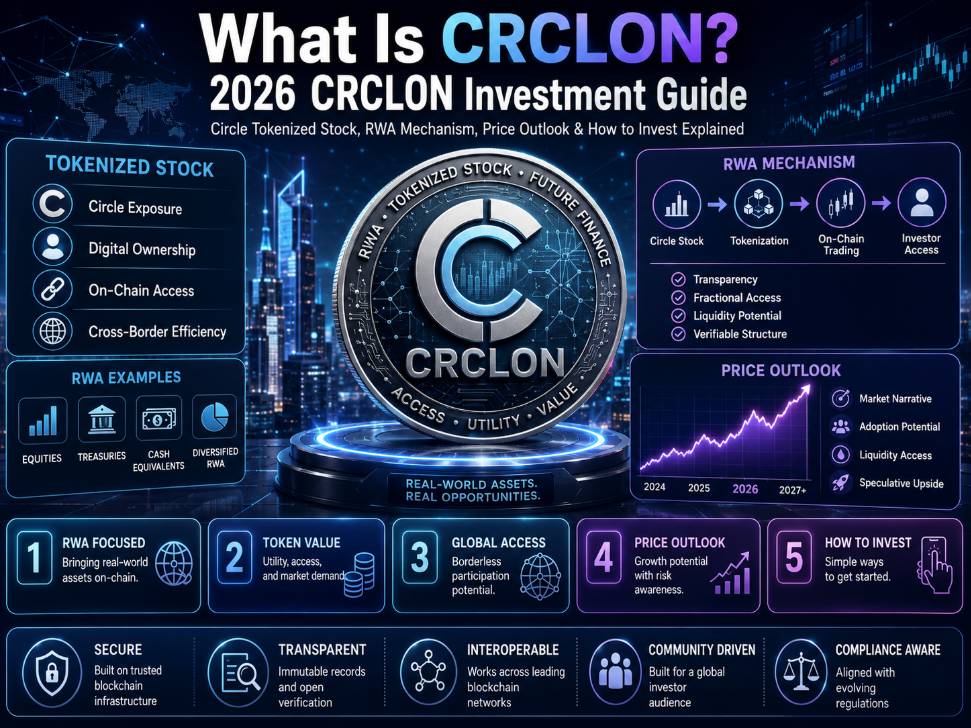
This section answers: Why are traditional stocks moving into crypto?
The traditional stock investment path is typically:
Investor → Brokerage Account → Broker System → Stock Exchange → Clearing & Custody → Exchange Trading Hours
Tokenized stocks offer an alternative path:
Investor → Blockchain Wallet or Supported Platform → Tokenized Asset → On-Chain Transfer or Platform Trading → More Flexible Market Access → Potential Integration with DeFi
Potential advantages of stock tokenization include:
- Enhanced global accessibility
- Improved on-chain liquidity
- Lower barriers for some users to access traditional finance
- Combination with DeFi, lending, collateralization, portfolio management, and other on-chain financial applications
- Familiarity for crypto users comfortable with USDT, USDC, and wallets
Ondo’s documentation states that Ondo Global Markets tokenizes publicly traded US stocks and ETFs as ERC-20 assets, allowing non‑US investors to mint, transfer, and redeem equity-backed tokens on public blockchains like Ethereum.
However, tokenization is not without restrictions. Ondo’s website also clarifies that Ondo Stocks-related tokens are not registered under US securities laws and may be subject to regional, eligibility, and redemption limitations.
So, CRCLON’s opportunity comes from on‑chain stock exposure, but its risks stem from securities regulation, asset structure, and platform rules.
4. CRCLON vs. Circle Stock (CRCL): What’s the Difference?
This section answers: Does buying CRCLON equal buying Circle stock?
Not exactly.
CRCL is Circle Internet Group’s ticker on traditional securities markets. Circle is a public company, and its investor relations page shows the ticker NYSE: CRCL.
CRCLON is the on-chain tokenized asset tied to Circle stock. It can provide similar economic exposure, but it should not be equated with directly holding CRCL shares in a brokerage account.
Key differences include:
Trading Method
- CRCL: Traded through traditional brokerage accounts and stock exchanges.
- CRCLON: Traded via platforms that support tokenized stocks or crypto exchanges.
Holding Method
- CRCL: Held in brokerage accounts or securities custody systems.
- CRCLON: Held in blockchain wallets, smart contracts, or exchange accounts.
Legal Rights
- Direct stock ownership typically involves shareholder rights, voting rights, dividends, securities law protections, and brokerage custody rules.
- For CRCLON, whether it carries voting rights, dividend entitlements, redemption rights, underlying asset backing, and legal protections depends on the issuer’s documents, platform rules, and investor eligibility. CoinMarketCap’s description says it offers economic exposure similar to holding CRCL with dividend reinvestment, but that does not automatically grant all holders traditional shareholder rights.
Thus, investors must understand: CRCLON is an on-chain asset representation, not the CRCL stock itself held in a traditional account.
5. Does CRCLON Represent Shareholder Rights?
This is a crucial question for all tokenized stock investors.
CRCLON is fundamentally about economic exposure, not about being a shareholder per se.
Investors should verify:
- Does it grant voting rights?
- Are dividends paid?
- Are dividends automatically reinvested?
- Can it be redeemed for underlying stock?
- Are only specific regions or accredited investors eligible?
- Is there real stock custody?
- Is there third-party auditing and proof of reserves?
- Are minting or redemptions subject to suspension?
Ondo’s website explains that its tokenized stocks are designed as total‑return trackers of the underlying securities. Also, minting and redemptions may be paused due to corporate actions, market volatility, trading session transitions, or system risk controls.
Therefore, CRCLON investors should not only look at price correlation with CRCL but also carefully assess the asset structure and legal rights.
6. The RWA Mechanism Behind CRCLON: How Real Stocks Become Blockchain Assets
This section explains: How does a stock become a token?
RWA stands for Real World Assets – the on‑chain representation of real‑world assets. This includes stocks, bonds, real estate, commodities, funds, treasuries, notes, and other financial assets.
Tokenized stock is one of the most intuitive RWA categories because it converts traditional equities into on‑chain representations.
A typical process looks like:
Traditional Stock → Custody/Support Structure → Token Issuance → Blockchain Network → Investor Trading → Potential DeFi Integration
For CRCLON, the underlying logic is that the value of Circle stock is tokenized into the crypto market. Investors are not trading a native blockchain token but an on‑chain asset tied to the economic value of a real stock.
RWA has become an important crypto sector because the market is moving from trading only native tokens to also trading real assets, financial yields, corporate equity, bond yields, and commodity prices.
For example, What is FXRP shows how XRP can be mapped into DeFi through asset wrapping. While FXRP is not a traditional stock‑based RWA, it – like CRCLON – highlights the trend of diverse assets seeking on‑chain liquidity and composability.
7. Circle’s Business Model: Where Does CRCLON’s Value Come From?
This section answers: What are you really investing in when you buy CRCLON?
CRCLON’s value foundation is not the token name itself, but Circle’s enterprise value and CRCL stock performance.
Circle’s core business can be summed up in three keywords: USDC, digital dollar infrastructure, and enterprise blockchain payments.
1. USDC Ecosystem
USDC is Circle’s most fundamental business. The larger the USDC circulation, the more active on‑chain transactions, and the greater enterprise and institutional adoption, the stronger Circle’s market position.
Reuters reported in August 2026 that Circle’s Q2 USDC circulation grew 19% to $73.3 billion, and USDC on‑chain transaction volume increased 151% year‑over‑year.
2. Stablecoin Financial Infrastructure
Stablecoins are the cash layer of crypto markets, and also critical for on‑chain payments, DeFi, RWA, cross‑border settlement, and corporate finance. If Circle can become the primary platform for enterprises and institutions to use digital dollars, its long‑term value may extend far beyond trading.
3. Interest and Reserve Income
Stablecoin issuers typically earn revenue from reserve assets. Circle’s income is influenced by USDC circulation, interest rates, distribution arrangements, regulatory requirements, and market competition. Circle’s Q1 2026 risk disclosures also note that interest rate fluctuations, USDC reserves, regulatory environment, competition, and yield‑bearing digital assets could affect its results.
Therefore, analyzing CRCLON fundamentally requires analyzing Circle as a company – not just looking at short‑term price charts.
8. How Does Stablecoin Market Growth Affect Circle’s Value?
Stablecoins are the base monetary instruments of the crypto financial system.
When users trade BTC, ETH, DeFi tokens, meme coins, RWA assets, or tokenized stocks, stablecoins are often used as the pricing and settlement currency.
When businesses conduct cross‑border payments, on‑chain settlements, or programmable finance operations, stablecoins serve as the digital dollar infrastructure.
If USDC usage grows, Circle may benefit from:
- More stablecoin circulation
- More enterprise payment demand
- More on‑chain settlement volume
- More RWA and tokenized asset use cases
- More developer and institutional integrations
- More opportunities for digital dollar infrastructure revenue
But investors must also consider risks. The stablecoin market is highly competitive – USDT, RLUSD, PYUSD, bank‑issued stablecoins, yield‑bearing tokens, and various payment networks could all impact USDC’s growth. Recent Barron’s coverage also highlighted market disagreements over USDC’s future circulation growth and the pace of stablecoin payment adoption.
So Circle’s value depends not just on “stablecoins will grow,” but on whether USDC can maintain market share, regulatory compliance, and enterprise adoption.
9. Circle and the Crypto Market Cycle
Circle’s business is closely related to crypto market cycles, but not perfectly correlated with token price cycles.
In bull markets, on‑chain activity increases and stablecoin demand typically rises – users need USDC for trading, market making, lending, arbitrage, DeFi strategies, and cross‑chain transfers.
In bear markets, trading demand may drop, but stablecoins remain important for capital preservation, on‑chain settlement, and liquidity management.
This gives Circle an infrastructure‑like quality – it doesn’t serve only one token, but provides dollar liquidity for the entire crypto financial system.
However, Circle is also affected by market downturns. If trading volume declines, interest rates fall, USDC growth slows, distribution costs rise, or regulatory costs increase, the company’s valuation may suffer.
Thus, CRCLON prices will be influenced by both Circle’s fundamentals and the broader crypto cycle.
10. Investment Thesis for CRCLON: Why Are Investors Interested in Circle Tokenized Stock?
This section answers: What is the investment value of CRCLON?
Investing in CRCLON should not be viewed as speculating on a new token, but rather as betting on three long‑term trends:
1. Stablecoin Growth
If stablecoins become a critical infrastructure for global payments, cross‑border settlement, DeFi, RWA, and enterprise on‑chain finance, Circle as the issuer of USDC and platform operator could enjoy substantial long‑term growth.
2. Digital Finance Development
Circle is evolving from a stablecoin issuer to a digital finance infrastructure company. Circle’s 2026 reports highlight that stablecoins, public blockchains, and programmable infrastructure are forming a new internet financial operating system.
3. Crypto Infrastructure Adoption
CRCLON as a tokenized stock allows crypto users to gain on‑chain or platform‑based exposure to Circle’s equity economics. This itself represents the convergence of traditional finance and crypto markets.
Potential advantages of CRCLON include:
- Bridging traditional finance and crypto
- Bringing Circle stock exposure into the blockchain asset ecosystem
- Offering a new participation method for users without traditional brokerage access
- Future integration with DeFi, collateralization, lending, and portfolio management
But these advantages depend on clear asset structure, platform compliance, sufficient liquidity, and continued growth in Circle’s fundamentals.
11. How Is CRCLON Different from Ordinary Crypto Tokens?
The biggest difference lies in the source of value.
Ordinary crypto tokens are typically valued by:
- Protocol usage
- Community growth
- Token utility
- On‑chain activity
- Total value locked (TVL)
- Trading volume
- Narrative hype
CRCLON, by contrast, should be evaluated by:
- Circle’s enterprise value
- CRCL stock performance
- USDC circulation
- Stablecoin market share
- Revenue and profit
- Regulatory environment
- Tokenized stock structure
- Liquidity and redemption mechanisms
Therefore, CRCLON is not about “buy a new coin and wait for a moonshot.” It is about “participating in Circle’s equity economics through crypto markets.”
This also means that CRCLON investors need to combine traditional stock analysis skills with crypto risk awareness.
12. How to Buy CRCLON? A Step‑by‑Step Guide for Beginners
This section answers: How do you buy CRCLON?
Step 1: Confirm Official Asset Information
Before purchasing, verify that you are buying the correct CRCLON token – the Circle Internet Group Tokenized Stock (Ondo) – and not a fake asset or different trading pair. Always refer to Ondo, exchange announcements, and Hibt’s price page.
Step 2: Understand the Underlying Stock Relationship
Know that CRCLON corresponds to economic exposure to Circle Internet Group stock, not a new token issued by Circle, and is not necessarily equivalent to directly holding CRCL shares.
Step 3: Check Regional and Compliance Restrictions
Tokenized stocks often involve securities regulation, and participation may be limited by region. Ondo’s website clearly states that these tokens are not registered under US securities laws.
Step 4: Prepare Funds
Depending on the platform, you may need USDT, USDC, USDON, or other supported assets. CoinGecko shows active trading pairs like CRCLON/USDON on Ondo Stocks.
Step 5: Choose a Supported Platform and Buy
Use a platform that supports CRCLON trading. Before placing an order, check price, volume, bid‑ask spread, trading hours, redemption rules, and platform risk disclosures.
Step 6: Manage Your Assets Securely
If the asset supports on‑chain wallet custody, protect your private keys and seed phrases. If held on an exchange account, monitor platform custody risks, account security, and withdrawal limits.
13. How to Check CRCLON Live Price?
You can view live data via Hibt’s price page:
Key metrics to watch:
- Real‑time price
- 24‑hour change
- Trading volume
- Market trends
- Exchange support
- Bid‑ask spread
- Historical performance
- Price correlation with CRCL stock
Note that CRCLON prices are influenced by Circle’s stock price, tokenized stock market liquidity, trading hours, platform rules, and crypto market sentiment.
14. CRCLON Price Prediction: How to Analyze Future Value?
This section answers: Will CRCLON go up in the future?
A CRCLON price prediction cannot be a fixed target; it should be based on asset valuation models, not meme‑coin style speculation.
You can check market trend references via CRCLON Price Prediction, but long‑term value depends on Circle’s business growth and the development of the tokenized stock market.
Core factors affecting CRCLON price fall into three categories:
1. Circle Fundamentals
USDC circulation, revenue growth, profitability, enterprise payment adoption, Arc blockchain development, stablecoin market share, and regulatory compliance.
2. Crypto Market Factors
Stablecoin demand, on‑chain transaction volume, DeFi activity, RWA asset growth, institutional capital inflow, and crypto cycles.
3. RWA Market Factors
Tokenized stock adoption, Ondo ecosystem growth, compliance pathways, demand from non‑US investors, secondary market liquidity, and institutional participation.
If Circle’s business grows, USDC adoption increases, and the RWA market expands, CRCLON could gain stronger support. Conversely, if Circle stock declines, stablecoin competition intensifies, tokenized stock liquidity dries up, or regulatory constraints tighten, CRCLON prices may face pressure.
15. CRCLON’s Relationship with Ethereum and the RWA Ecosystem
This section explains: Why does CRCLON need crypto infrastructure?
Tokenized assets typically rely on smart contracts, wallets, stablecoins, custody, and trading infrastructure.
Ethereum and its ecosystem are particularly important in the RWA space because of its mature DeFi protocols, stablecoin liquidity, wallet infrastructure, institutional acceptance, and ERC‑20 standard. Ondo’s documentation also notes that its tokenized stock system converts publicly traded stocks and ETFs into ERC‑20 assets.
You can also check ETH Price Prediction to see how Ethereum’s ecosystem influences tokenized stocks, RWA, and DeFi.
Looking ahead, CRCLON could potentially be used in deeper on‑chain financial applications such as:
- Collateral – used as collateral in lending markets
- Lending – as part of on‑chain financial portfolios
- Portfolio Management – combined with USDC, ETH, RWA, tokenized treasuries, etc.
- Trading – as an on‑chain vehicle for Circle stock exposure
Whether these scenarios materialize depends on compliance, liquidity, protocol support, and platform rules.
16. CRCLON Compared to Other Tokenized Asset Trends
This section helps build industry context.
CRCLON belongs to the tokenized stock and RWA sector. Its value stems from Circle’s enterprise value and stablecoin infrastructure growth.
What is ALABB represents another example of tokenized corporate assets – if it corresponds to Alibaba‑related assets, the analysis would focus on e‑commerce, cloud computing, AI, and Chinese tech valuations.
What is POPMART represents consumer brand and IP economy tokenization logic, focusing on brand assets, community, overseas growth, and consumption trends.
What is QUID is more about Web3 infrastructure and cross‑chain ecosystem tokens, with value derived from use cases, cross‑chain transaction demand, and tokenomics.
Different assets have completely different value drivers:
- CRCLON → Circle and USDC
- ALABB → underlying enterprise assets
- POPMART → IP economy and consumer brands
- QUID → Web3 applications and cross‑chain infrastructure
Investors should not look only at token prices; first, identify the asset class.
17. Risk Analysis for CRCLON
This section answers: Is CRCLON safe?
1. Regulatory Risk
CRCLON is a tokenized stock‑related asset, subject to securities regulation, investor qualifications, regional restrictions, custody rules, and disclosure requirements. Ondo’s website states that these tokens are not registered under US securities laws, meaning some users may be ineligible, or trading/redemption may be restricted.
2. Underlying Asset Risk
If Circle stock (CRCL) declines, CRCLON prices are likely to be affected. Circle’s business is influenced by USDC growth, interest rates, regulation, competition, distribution costs, and crypto market cycles.
3. Tokenization Risk
Tokenized stocks involve custody, issuance, redemption, smart contracts, platform risk controls, and price tracking mechanisms. Any failure in these components could cause CRCLON to deviate from the underlying asset or affect trading.
4. Liquidity Risk
If trading volume is low, bid‑ask spreads may widen, and large orders may incur slippage. Although CoinGecko shows CRCLON trading on Ondo Stocks, investors should continuously monitor volume and market depth.
5. Stablecoin Industry Risk
Circle is highly dependent on the stablecoin ecosystem. Changes in stablecoin regulation, competitor growth, falling interest rates, reserve management issues, or market confidence fluctuations could impact Circle’s valuation. Circle’s own risk disclosures mention stablecoin competition, redemption requests, reserve risks, regulatory changes, and interest rate volatility.
6. Crypto Security Risk
On‑chain assets require attention to both investment risk and asset security. You can read Coldcard Hack Explained to understand the importance of hardware wallets, private keys, seed phrases, contract approvals, and asset migration.
18. How to Judge Whether CRCLON Is Worth Investing In?
This section answers: What should you look at when evaluating CRCLON?
Use a three‑layer framework:
Layer 1: Enterprise Value
- Is Circle’s business growing?
- Is USDC market share stable?
- Is USDC circulation expanding?
- Are Circle’s revenue and profit improving?
- Are enterprise payments and RWA use cases increasing?
- Is the regulatory environment supportive of stablecoin development?
Layer 2: Token Structure
- Does CRCLON truly track CRCL stock?
- Is there underlying asset backing?
- Is there clear custody and redemption mechanism?
- Is on‑chain transfer supported?
- Is liquidity sufficient?
- Are there regional restrictions?
Layer 3: Industry Trends
- Is the RWA market growing?
- Are tokenized stocks being adopted by more investors?
- Is the stablecoin market expanding?
- Are institutions continuing to enter crypto financial infrastructure?
- Are Ethereum and DeFi ecosystems supporting more real‑world assets?
Only when enterprise value, token structure, and industry trends are all clear can the investment case for CRCLON be considered complete.
19. Suggested Data Modules to Add
To enhance E‑E‑A‑T (Experience, Expertise, Authoritativeness, Trustworthiness), we recommend adding the following dynamic data modules to the published page:
Circle Business Metrics
Show USDC circulation, USDC market share, revenue growth, net income, transaction volume, enterprise adoption, and Arc ecosystem progress.
Core explanation: CRCLON’s fundamental value comes from Circle’s business fundamentals, not the token name.
CRCLON Asset Metrics
Show CRCLON token supply, trading volume, liquidity, market depth, premium/discount to CRCL, available exchanges, and redemption availability.
Core explanation: The most important question for tokenized stocks is whether the price effectively tracks the underlying stock.
RWA Comparison
Highlight differences among CRCLON, traditional CRCL stock, and ordinary crypto tokens:
- CRCLON → economic exposure to Circle stock
- Traditional CRCL stock → shareholder rights and securities market rules
- Ordinary crypto tokens → protocol usage, network effects, and token utility
Risk Metrics
Show regulatory risk, underlying stock risk, custody risk, liquidity risk, price deviation risk, and wallet security risk.
Core explanation: RWA is not risk‑free – it combines traditional financial risks with crypto risks.
20. FAQ: Common Questions About CRCLON
What is CRCLON?
CRCLON is a tokenized representation linked to Circle Internet Group equity exposure. It is designed to provide blockchain‑based economic exposure to Circle Internet Group, whose traditional stock trades under the ticker CRCL. CoinMarketCap describes CRCLon as the Ondo Tokenized version of Circle Internet Group.
Is CRCLON the same as Circle stock?
No. CRCLON is not the same as directly holding Circle stock through a traditional brokerage account. It is a blockchain‑based representation or tokenized asset, and investors should verify ownership rights, redemption rules, eligibility, and platform terms.
What is the difference between CRCLON and CRCL?
CRCL is Circle Internet Group’s traditional stock ticker, operating within the securities market system. CRCLON is a tokenized stock asset related to Circle’s economic exposure, operating within the crypto or on‑chain asset system. Their prices may be correlated, but legal rights and trading methods differ.
Is CRCLON a cryptocurrency?
CRCLON is a tokenized asset tradable in crypto markets, but it is not a native cryptocurrency like BTC or ETH. It is closer to an RWA asset – the on‑chain representation of real stock assets.
How to invest in CRCLON?
Users can participate through platforms that support CRCLON trading or tokenized stock platforms. Before investing, always verify official asset information, trading pairs, underlying stock relationships, regional restrictions, custody structures, and redemption rules. You can also check market performance via CRCLON Live Price.
How to interpret CRCLON price predictions?
CRCLON price predictions should factor in Circle’s business growth, USDC stablecoin adoption, CRCL stock performance, tokenized stock liquidity, RWA market demand, and regulatory environment. You can refer to CRCLON Price Prediction for reference, but never treat predictions as guaranteed returns.
Is CRCLON suitable for long‑term investment?
Whether it is suitable depends on Circle’s fundamentals, USDC growth, token structure, liquidity, and regulatory landscape. If you are bullish on stablecoin infrastructure and RWA development, and can accept tokenized stock risks, CRCLON may be worth researching. However, it is not suitable for beginners who do not understand the asset structure to make large allocations.
Where does CRCLON’s future potential come from?
CRCLON’s future potential primarily comes from Circle’s business growth, expansion of the stablecoin market, USDC adoption in payments and DeFi, development of tokenized stock markets, increased RWA liquidity, and institutional capital inflows.
21. Summary: Is CRCLON Worth Investing In?
CRCLON is worth paying attention to, but it should not be simplistically viewed as “Circle stock on‑chain will definitely go up.”
Strengths:
- CRCLON connects to Circle, a major crypto financial infrastructure company.
- Circle is one of the core companies behind the USDC stablecoin.
- Growth in stablecoins, RWA, DeFi, and on‑chain payments could enhance Circle’s long‑term value.
- CRCLON brings Circle stock exposure into the crypto trading environment, aligning with tokenized stock and RWA trends.
- If on‑chain assets can be used for collateral, lending, and portfolio management, CRCLON may gain more financial use cases.
Risks:
- CRCLON is not equivalent to directly holding CRCL stock.
- Tokenized stocks face securities regulation, regional restrictions, and legal uncertainty.
- Circle stock price may decline.
- Stablecoin competition is fierce.
- CRCLON may suffer from low liquidity and price deviation.
- On‑chain assets also require attention to wallet security and platform custody risks.
For beginners, the most important things to do before investing in CRCLON are:
1. Confirm the asset structure. Does CRCLON genuinely correspond to Circle stock economic exposure? Is there a custody and redemption mechanism?
2. Research Circle’s fundamentals. Are USDC circulation, revenue, profit, stablecoin market share, and enterprise payment adoption growing?
3. Control investment risk. Tokenized stocks carry both traditional stock risks and crypto trading, regulatory, and liquidity risks.
A more rational approach is to first observe market performance via CRCLON Live Price, then combine insights from CRCLON Price Prediction, ETH Price Prediction, What is FXRP, What is ALABB, What is POPMART, What is QUID, and Coldcard Hack Explained to build a comprehensive understanding of RWA, tokenized stocks, and crypto asset security.
CRCLON’s long‑term value ultimately depends on whether Circle can continue to expand USDC and digital finance infrastructure influence, and whether the tokenized stock market can mature in terms of compliance, custody, liquidity, and investor protection. For investors, CRCLON is not a simple new‑coin opportunity, but an important case study of the convergence of traditional financial assets and crypto markets.