
Written by Hibt Crypto Research Team
Updated: August 2026
In the crypto market, infrastructure projects often don't catch the average user's eye like meme tokens do, nor do they directly face traders like exchange tokens. But they may underpin a vast number of on-chain applications. MUON is exactly that kind of project.
For anyone searching "what is MUON," "MUON crypto," "MUON token," or "how to buy MUON" for the first time, the most important questions are: Is MUON a cryptocurrency? What problem does it solve? Why are people paying attention to it? And how does MUON relate to oracles, automation, cross‑chain, and AI agents in Web3 infrastructure?
Simply put, the MUON discussed here refers primarily to the native token of Muon Protocol and the Web3 infrastructure network behind it. The official Muon development documentation defines Muon as a decentralized optimistic oracle network that can process data requests from any data source and serve as a cross‑chain data availability network, providing secure data interfaces and messaging capabilities between otherwise incompatible blockchains.
A critical note: there is also a similarly named Micron Technology Tokenized Stock (Ondo), which displays as MUon on some platforms. That is a tokenized stock asset tied to Micron Technology, not the Muon Protocol infrastructure token covered here. CoinMarketCap lists that MUon under the Ondo Tokenized Stock category. Investors must distinguish clearly between the two to avoid buying the wrong asset.
1. What Is MUON? Why Is It Considered Next‑Gen Web3 Infrastructure?
This chapter answers: What problem does MUON actually solve?
In one sentence: MUON is a decentralized verification and oracle infrastructure for Web3 applications, designed to let smart contracts securely fetch external data, process complex logic, complete cross‑chain verification, and deliver trusted results back on‑chain.
The defining feature of traditional blockchains is determinism. Smart contracts can only execute based on existing on‑chain state; they cannot actively access the internet, read Web2 APIs, judge complex events, or freely sync data across multiple chains like ordinary servers.
This creates a problem: if a DeFi protocol needs price data, a gaming contract needs randomness, a bridge needs confirmation of a transaction on another chain, or an AI agent needs to call on‑chain services — the smart contract itself cannot independently handle these tasks.
Muon aims to solve exactly that. It lets developers build Muon Apps, where nodes in the Muon network process data, verify results, sign them, and deliver the outputs to smart contracts. The official documentation explains that a Muon App can read and process off‑chain data and produce outputs that smart contracts can reliably use.
Therefore, MUON is not a simple payment coin or a meme token — it’s the token of a Web3 infrastructure project.
2. Why Does Web3 Need MUON?
Web3 applications currently face three clear limitations.
First, smart contracts cannot actively fetch external data.
For example, ETH price, stock prices, off‑chain order books, weather data, sports results, or real‑world events are not on‑chain. If a smart contract needs any of that, it must rely on an oracle.
Second, smart contracts cannot efficiently execute complex tasks.
On‑chain computation is expensive; putting all complex logic on‑chain burns excessive gas. Many Web3 applications need to perform part of the computation off‑chain and then securely submit the result on‑chain.
Third, the multi‑chain ecosystem lacks native interoperability.
Chains like Ethereum, Avalanche, BNB Chain, Solana, and Base each have their own state and applications. A smart contract on one chain cannot natively know what happened on another. Cross‑chain communication, verification, and multi‑chain data availability thus become infrastructure needs.
Muon's value lies here. It does not offer entertainment or trading products directly to end‑users; instead, it provides underlying data and verification capabilities to DApps, DeFi, cross‑chain protocols, and Web3 applications.
Think of it this way:
Blockchain applications
↓
Need off‑chain data
↓
Need node verification
↓
Need secure signatures
↓
Need results submitted on‑chain
↓
Muon provides the infrastructure support
The Ethereum ecosystem has driven massive DeFi and Web3 growth, which in turn fuels continued demand for oracles, automation, cross‑chain, and data layers. Users can check the ETH Price Prediction to observe the long‑term impact of the Ethereum ecosystem on infrastructure projects.
3. Which Crypto Sector Does MUON Belong To?
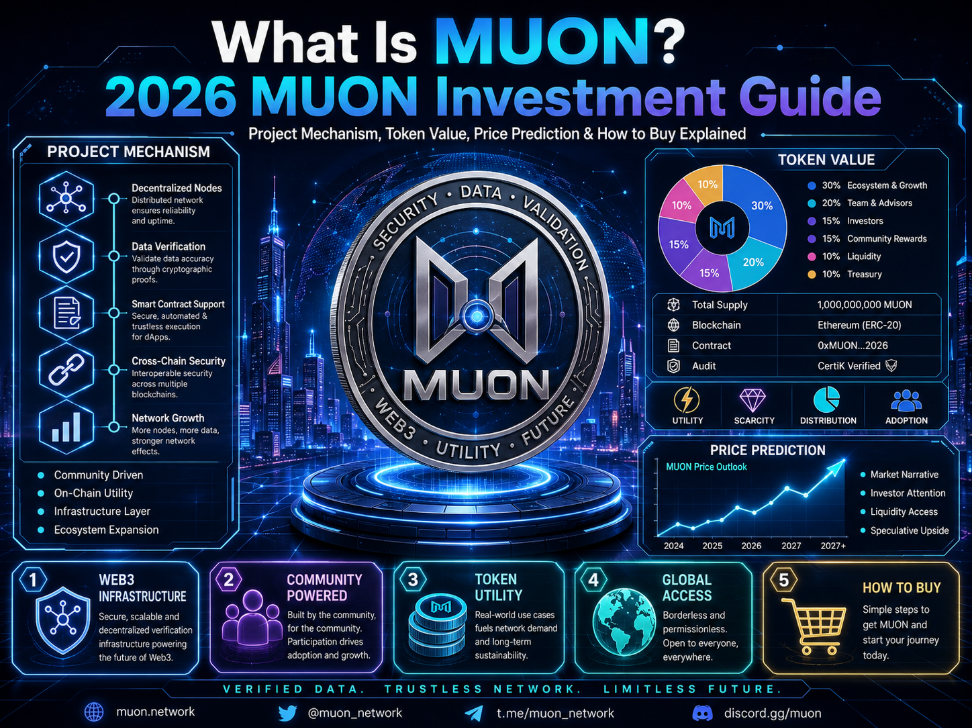
Crypto development can be roughly divided into phases.
Phase 1 – The Bitcoin era. BTC represents digital gold and decentralized value storage.
Phase 2 – The Ethereum era. ETH represents smart contracts and the on‑chain application platform.
Phase 3 – The Web3 infrastructure era. This phase focuses not just on "the chain itself," but on the underlying components that on‑chain applications need — including oracles, automation, cross‑chain, data layers, AI agent infrastructure, verification networks, and modular services.
MUON belongs to the third category — more oriented toward Web3 infrastructure and decentralized verification networks.
It differs from typical application tokens. Application tokens usually serve a specific product — a game, a trading platform, or a community. Infrastructure tokens derive value from developer integrations, protocol calls, secure operation, and network effects.
Muon’s official story page also notes that the project was started in 2022 by Web3 builders aiming to address scalability, interoperability, and security limitations. Its ALICE testnet once had over 1,500 independent validator nodes, and the Pion Canary network had over 1,000 nodes. The Muon protocol and native token went live on April 9, 2025.
This shows that MUON’s narrative is not about short‑term hype, but about Web3 application infrastructure.
4. MUON Technical Architecture: How Does It Let Blockchain Applications Automate Tasks?
This chapter answers: How does MUON give smart contracts off‑chain capabilities?
One of the biggest issues in Web3 applications is that smart contracts cannot actively run themselves.
A smart contract only executes when called by a user or an external account. It cannot periodically query prices, monitor risks, confirm cross‑chain states, or fetch data from Web2 APIs on its own.
Therefore, Web3 applications need three types of external capabilities.
First, Oracle.
Oracles bring off‑chain data on‑chain — prices, event outcomes, off‑chain computation results, etc.
Second, Automation.
Automation triggers actions when conditions are met — liquidations, dollar‑cost averaging, rebalancing, scheduled tasks, strategy execution.
Third, External Data and Computation.
Some complex computations are too heavy to run entirely on‑chain; they need to be executed off‑chain and then the results submitted on‑chain.
Muon provides these capabilities through its node network and Muon Apps. Developers can write application logic, Muon nodes process requests, fetch data, compute results, and sign them, and smart contracts verify the signed results.
An example in the official docs shows a simple Muon App fetching ETH price, using onRequest to handle requests and signParams to define the data parameters to be signed.
This illustrates that Muon is not merely a price oracle — it is a more general data and verification layer.
5. What Are the Core Components of the Muon Network?
The Muon network can be understood at four layers.
First, Node.
Nodes execute requests, process data, and generate signed results. The security of an infrastructure network depends heavily on node count, node quality, incentive mechanisms, and penalty mechanisms.
Second, Network.
The Muon network coordinates multiple nodes to handle requests together, avoiding single‑point server failures or attacks. Compared to a single oracle server, a decentralized node network reduces the risk of data tampering.
Third, Execution Layer.
The execution layer runs Muon Apps — the specific data‑processing logic, such as price fetching, cross‑chain verification, random number generation, risk calculations, etc.
Fourth, Data Layer.
The data layer connects on‑chain and off‑chain data sources, allowing DApps to securely use external information.
CoinGecko’s project description also emphasizes that Muon is a decentralized universal verification layer that lets DApps run off‑chain micro‑validators, processing, verifying, and signing data before pushing it on‑chain. Its modular architecture involves TSS, Shield Nodes, and EigenLayer security components.
For investors, understanding these components matters because MUON’s value comes from real network usage, not just a "cool concept."
6. How Does MUON Differ from Oracle and Automation Protocols?
This section is an SEO opportunity — keywords include MUON vs Chainlink, MUON oracle, blockchain automation.
Chainlink is the most well‑known oracle project, providing price data, Proof of Reserve, automation, and cross‑chain communication for DeFi and Web3. Muon, by contrast, emphasizes a "universal verification layer" and custom Muon Apps, letting developers build more flexible data processing and signing services.
Think of it this way:
- Traditional oracles are more like "providing standard data feeds."
- Automation protocols are more like "triggering a specific on‑chain action."
- Muon is more like "letting developers deploy custom verification logic, executed, verified, and signed by a node network."
This doesn’t mean Muon is necessarily superior to Chainlink. Their positioning differs, and so do their ecosystem sizes. Chainlink already has much more mature market recognition and broader integrations, while Muon needs to prove its differentiation in custom verification, cross‑chain data, low‑cost execution, and developer experience.
For investors, comparing infrastructure projects shouldn't be about "which concept is newer," but about real integrations, real usage, real fees, and real network security.
7. MUON Use‑Case Analysis: What Could It Be Used for in the Future?
This chapter answers: Where is the real demand for MUON?
MUON’s potential use cases stem mainly from DeFi, AI agents, cross‑chain protocols, and Web3 automation.
In DeFi, Muon can provide price data, LP token valuations, risk parameters, liquidation triggers, yield strategy calculations, cross‑chain asset verification, and automated trading logic. The official docs include a TWAP price calculation example, showing how Muon Apps handle price data.
In cross‑chain finance, Muon can verify states or events on another chain. For example, a protocol may need to confirm that a user completed an action on another chain, or that a cross‑chain transaction met certain conditions — requiring a trusted verification layer.
In the AI agent trend, Muon’s significance may be even greater. In the future, AI agents may autonomously call on‑chain services — automatically trading, lending, monitoring risks, executing tasks. If AI agents are to use blockchains securely, they need reliable external data, cross‑chain verification, and automated execution infrastructure.
In Web3 applications, Muon is similar to servers and data interfaces on the internet. End‑users may not see it, but it supports the normal operation of applications. Just as users don’t care about servers, databases, and APIs when visiting a website — but without them, the site cannot run.
8. MUON and the Evolution of AI Agents
AI agents are becoming a major trend in crypto. In the future, AI agents may not just be chatbots — they could be intelligent agents capable of independently performing on‑chain tasks.
For example:
- Automatically analyzing wallet risk.
- Automatically executing DeFi strategies.
- Automatically monitoring liquidation risks.
- Automatically reallocating cross‑chain assets.
- Automatically calling data sources and smart contracts.
But for AI agents to enter the on‑chain world, they need trusted data, permission controls, verifiable execution, and cross‑chain infrastructure. A verification layer like Muon can become one of the underlying tools for AI agents to interact with blockchains.
This is also why MUON should not be viewed only as a traditional oracle project, but studied within the broader trend of Web3 automation and AI agent infrastructure.
Of course, this is a potential direction. What truly determines MUON’s value is not whether "the AI agent narrative is hot," but whether Muon is actually adopted by AI agent applications, DeFi protocols, and cross‑chain projects.
9. MUON Tokenomics: How Does the Token Capture Ecosystem Value?
This chapter answers: How does the MUON token generate value?
Infrastructure token value comes from network usage, node incentives, security mechanisms, and ecosystem demand. MUON may serve several functions.
First, Payment.
If DApps or developers pay fees to use Muon network services, MUON may become the payment medium or settlement token for those services.
Second, Staking.
Node operators or participants may need to stake MUON to gain service rights, improve security, or participate in network validation. The key question for staking: does it effectively constrain node behavior, or just offer nominal yields?
Third, Security.
Infrastructure networks need to prevent malicious nodes from providing false data. Tokens can be used for collateral, penalties, and incentives, giving nodes economic reasons to act honestly.
Fourth, Governance.
MUON holders may eventually participate in voting on protocol parameters, fee models, network upgrades, and ecosystem fund allocation.
Fifth, Node Incentives.
Nodes that process requests, verify data, and sign results need rewards. MUON can be used to compensate node operators, forming the economic basis for network operation.
Tokenomics.com also describes Muon Network as relying on an incentivized node network to process and sign on‑demand data, using threshold signature schemes to ensure data integrity when submitted to smart contracts. The MUON token is used to incentivize nodes, strengthen network security, and drive ecosystem adoption.
So when investing in MUON, the most important question is not "does the token have a use," but "can network usage sustainably increase token demand."
10. How Does Muon Network Growth Drive Token Demand?
MUON’s value‑growth logic can be understood as:
More DApps integrating Muon
↓
More data requests and verification tasks
↓
More nodes joining the network
↓
More tokens used for payment, staking, or incentives
↓
Increased ecosystem demand
↓
Stronger token value foundation
But this logic holds only if Muon generates real usage.
If no DApps call it, no developers integrate, and no node demand exists, token utility remains conceptual.
Therefore, investors should track:
- Whether Muon Apps count is increasing.
- Whether well‑known DeFi or cross‑chain projects are integrating.
- Whether node count is growing.
- Whether network request volume is rising.
- Whether the developer community is active.
- Whether token payments and staking are actually occurring.
Infrastructure projects often build value through long‑term accumulation, not short‑term spikes.
11. How Does MUON’s Inflation Model Affect Long‑Term Value?
The core of tokenomics is supply and demand.
If new supply grows faster than ecosystem demand, token price may face pressure.
If ecosystem demand grows faster than new supply, token value finds easier support.
According to Tokenomics.com, Muon Network’s maximum total supply is 1 billion MUON, with current total supply around 116,036,480 MUON, and circulating supply about 11.6% of the total. Allocation: community‑related pools 47%, insiders 25%, private investors 13%, foundation 9%, public investors 6%.
This means MUON still has a long release schedule. Tokenomics.com also shows that Muon’s full unlock period is approximately 11 years, with about 11.62% released in Year 1 and the remainder over the next 10 years.
Investors must understand: even technically solid infrastructure projects can be affected by unlock pressure. Release cadence, market liquidity, and ecosystem demand must all be analyzed together.
Users can refer to Solana Inflation Mechanism Explained to understand how different crypto projects manage supply. Solana uses protocol inflation to secure its network, while MUON requires more attention to the balance between unlocks, staking, node incentives, and ecosystem usage.
12. Muon Ecosystem Development: Does the Project Have Long‑Term Viability?
This chapter answers: Is MUON just a concept?
To judge whether MUON has long‑term competitiveness, look at three levels.
First, does the technology genuinely solve a real problem?
Muon does target genuine Web3 pain points: smart contracts can’t actively fetch data, can’t efficiently execute complex off‑chain computations, and can’t natively collaborate across chains.
Second, is anyone using the ecosystem?
The most important thing for an infrastructure project is not its whitepaper but its integrations, request volume, developer activity, and real protocol adoption. If only token trading exists with no application calls, long‑term value will be weak.
Third, is network effect strengthening?
Once an infrastructure network gains more developers, it creates a positive flywheel: more apps bring more requests, more requests attract more nodes, more nodes improve security and availability, which in turn attracts more apps.
Muon’s official story page indicates that during testnet, there were over 1,500 independent validator nodes and over 1,000 nodes on the Pion Canary network, with the protocol and token launching in April 2025. These data show a certain history and node base, but investors still need to continuously track real usage after mainnet.
13. How to Evaluate the Quality of a Web3 Infrastructure Project?
To analyze a project like MUON, use a simple framework.
First, technology.
Does it solve a real problem? Is there usable documentation? Can developers build applications? Has the system been audited? Is data processing secure?
Second, ecosystem.
Are there real project integrations? Are DApps calling it? Are there partners? Is there an active developer community? Are there ongoing updates?
Third, network effects.
More nodes, more calls, more developers, richer ecosystem — the stronger the infrastructure value.
Fourth, token capture.
Does the token truly participate in payments, staking, governance, incentives, and security? If the token is decoupled from network usage, project growth may not translate into token value.
Fifth, competition.
The oracle, automation, cross‑chain, and data layer space is highly competitive. Muon needs a clear differentiator, not just repetition of existing protocols.
14. How Does MUON Differ from Other Crypto Infrastructure Projects?
MUON can be compared to three types of infrastructure projects.
First, oracle projects.
These primarily provide price data and off‑chain information. Muon can act as an oracle too, but it places more emphasis on custom verification logic and Muon Apps.
Second, cross‑chain projects.
These focus on asset and message flows between chains. Muon’s documentation states it can serve as an inter‑blockchain data‑availability network, enabling messaging and secure data interfaces between incompatible chains.
Third, AI infrastructure projects.
These focus on AI agents, data calls, automated execution, and on‑chain service composition. If Muon is adopted by AI agent scenarios, it enters this trend.
The core differentiator: Muon is not a single‑point data source, but a universal verification layer. It allows DApp developers to build Muon Apps tailored to their specific needs, rather than only using standardized data interfaces.
15. How to Buy MUON? A Step‑by‑Step Guide for Beginners
This chapter answers: How to buy MUON?
Step 1 – Confirm official token information.
Before buying MUON, verify that you are purchasing Muon Protocol’s MUON, not the Micron Technology Tokenized Stock (MUon) or any other similarly named asset. CoinGecko shows Muon’s contract address on Avalanche as 0x6b1ecf0c181afff3d7096b26c3d2bc31f55ceab9, but always check official channels and exchange announcements before trading.
Step 2 – Choose a trading platform.
CoinGecko shows that MUON is currently tradable on decentralized exchanges, with the main active pair being MUON/WAVAX on LFJ. However, its 24‑hour trading volume is low, so liquidity risk should be a primary concern.
Step 3 – Prepare a wallet and base assets.
If buying via an Avalanche DEX, you need a wallet that supports Avalanche C‑Chain, hold AVAX for gas fees, and have WAVAX or other trading assets.
Step 4 – Connect to the trading platform.
Go to the DEX that supports MUON, confirm the contract address and trading pair, and check price impact, slippage, trading volume, and liquidity pool depth.
Step 5 – Start with a small test.
Infrastructure tokens with small market caps often have low liquidity. Beginners should avoid large one‑time purchases. Test with a small amount first to confirm that buying, displaying, and selling all work correctly.
Step 6 – Store securely.
After purchasing, you can keep tokens in a self‑custodial wallet or on the platform if supported. Self‑custody users must safeguard private keys and seed phrases and avoid connecting to unknown DApps.
16. How to Check MUON Real‑Time Prices?
Users can view MUON market data through the HIBT quotes page:
On the quotes page, focus on:
- Current price
- 24‑hour change
- Trading volume
- Market depth
- Liquidity changes
- Exchange support
- Historical price trends
Also note: if MUON is available on different platforms or chains with different trading pairs, confirm that the pair corresponds to Muon Protocol, not another asset with a similar name.
17. MUON Price Prediction: How to Analyze Future Value?
This chapter answers: Does MUON have upside potential?
MUON price prediction cannot simply give a fixed number. Infrastructure project prices are driven by technology adoption, ecosystem growth, token supply/demand, unlock pressure, and market cycles.
Users can check MUON Price Prediction, but any prediction is only a market reference, not a substitute for fundamental research.
Three core factors influence MUON’s price:
First, technology adoption.
If more DApps, DeFi protocols, cross‑chain projects, or AI agents integrate Muon, network request volume and token demand may rise.
Second, market demand.
The stronger the demand for Web3 infrastructure, AI agents, cross‑chain finance, and DeFi automation, the larger the narrative space for projects like Muon.
Third, token supply.
MUON remains on a long‑term unlock schedule; future unlocks, circulating supply changes, and market absorption capacity will affect price. Tokenomics.com shows Muon’s full unlock period spans 11 years, so investors need to watch long‑term supply.
Therefore, MUON price prediction should focus on long‑term adoption, not just short‑term charts.
18. MUON and Current Crypto Trends
This chapter answers: Does MUON align with future crypto directions?
AI Crypto Trend
AI is changing how blockchain applications work. In the future, AI agents may autonomously call on‑chain services — executing trades, monitoring risks, managing wallets, and allocating assets. Infrastructure projects that can provide data, verification, and execution for AI agents may enter a significant growth trajectory.
For example, What is AIRH covers AI Robotics and asset tokenization. MUON is more of a foundational infrastructure layer that could serve AI agents and Web3 automation.
RWA Trend
RWA brings real‑world assets into crypto. RWA needs trusted data, price verification, cross‑chain liquidity, and smart contract execution capabilities.
For example, What is ALABB represents the tokenization of traditional assets. If more stocks, commodities, funds, or brand assets come on‑chain, they will require more data and financial infrastructure support.
DeFi Asset Financialization Trend
DeFi is moving beyond simple swaps and lending toward more complex portfolio strategies, collateral management, and cross‑chain liquidity. For instance, What is FXRP shows how XRP can enter DeFi lending and collateral scenarios through Flare FAssets.
These trends all need reliable oracles, cross‑chain verification, and automation infrastructure. MUON’s long‑term opportunity also comes from whether these applications actually grow.
19. MUON Investment Risks: What to Watch Before Investing?
This chapter answers: What are the risks with MUON?
First, technical risk.
MUON involves oracles, node networks, signature schemes, cross‑chain verification, and off‑chain computation. Any smart contract vulnerabilities, node security issues, data verification errors, or system design flaws could undermine project credibility.
Second, market competition risk.
The infrastructure space is fiercely competitive. Chainlink, Pyth, Gelato, LayerZero, Wormhole, EigenLayer‑related services, and other oracle/automation protocols may overlap with Muon’s business. Muon needs to prove its differentiation.
Third, adoption risk.
The biggest fear for infrastructure projects is "technology exists, but no one uses it." If DApp integrations are few, request volume low, and ecosystem growth slow, token value will struggle to find support.
Fourth, tokenomic risk.
MUON has a long‑term unlock schedule with ongoing circulation pressure. Tokenomics.com shows a max supply of 1 billion MUON, with a still‑low current release ratio and years of future unlocks.
Fifth, liquidity risk.
CoinGecko shows low trading volume for Muon, with active pairs mainly on DEXs. Low liquidity can widen bid‑ask spreads, increase slippage, and make large trades difficult.
Sixth, name‑confusion risk.
MUON and the Micron Technology Tokenized Stock (MUon) share a similar ticker; the latter is a tokenized equity asset. Investors must verify contract addresses and project sources before trading.
Seventh, wallet security risk.
Investing in crypto requires not only project due diligence but also asset protection. Read Coldcard Hack Explained to understand the importance of hardware wallets, seed phrases, contract approvals, and asset management.
20. MUON vs. Other Crypto Asset Investment Logics
This chapter helps users build a crypto research framework.
Infrastructure Tokens
MUON falls into this category. Value comes from technology adoption, node networks, developer integrations, and ecosystem growth. Analysis focuses on: real demand, real project usage, and token capture of network value.
RWA Tokens
RWA token value derives from underlying real‑world assets. For example, What is POPMART is better analyzed from consumer brand, IP economics, corporate fundamentals, and tokenized asset structure.
Emerging Application Tokens
Application tokens focus on products and users. For example, What is QUID represents cross‑chain applications and Web3 infrastructure ecosystem tokens — analysis needs to look at product usage, token utility, unlocks, and liquidity.
Different assets cannot be compared by price alone.
- MUON → infrastructure adoption.
- RWA → underlying assets.
- App tokens → user growth.
- Meme tokens → community spread and liquidity.
21. How to Decide Whether MUON Is Worth Investing In?
This chapter answers: What should you look at when investing in MUON?
A three‑layer framework:
Layer 1 – Project level.
- Is MUON’s technology real?
- Does it solve smart contract external data and cross‑chain verification problems?
- Is there developer documentation and usable applications?
- Are there real integration projects?
- Is the node network stable?
If the project level lacks real usage, long‑term token value will be weak.
Layer 2 – Token level.
- Does MUON have a clear utility?
- Is it used for payments, staking, governance, node incentives, or network security?
- Is the supply release healthy?
- Is liquidity sufficient?
- Is there unlock pressure?
The token level determines whether investors can translate project growth into asset value.
Layer 3 – Market level.
- Is Web3 infrastructure in a growth cycle?
- Are AI agents, DeFi, RWA, and cross‑chain demand strengthening?
- Does the crypto market have enough liquidity?
- Is infrastructure sector valuation reasonable?
The market level determines short‑ to medium‑term price elasticity.
22. FAQ: Common Questions About MUON
What is MUON?
MUON is the native token of Muon Protocol, a decentralized Web3 validation and optimistic oracle network designed to help blockchain applications securely access external data, off‑chain computation, and cross‑chain information. The official Muon development documentation describes it as a decentralized optimistic oracle network and a cross‑chain data availability network connecting different chains.
What does MUON mean?
MUON can be understood as the infrastructure token of the Muon Protocol ecosystem. Muon provides DApps with data requests, external data processing, verification, and signing services, helping smart contracts use off‑chain data and cross‑chain information.
Is MUON a cryptocurrency?
Yes, MUON is a crypto token. But it is not a native public‑chain asset like Bitcoin or Ethereum, nor is it a meme token — it is an ecosystem token of a Web3 infrastructure project.
Is MUON the same as Micron Technology Tokenized Stock (MUon)?
No. Muon Protocol’s MUON is a Web3 infrastructure token; Micron Technology Tokenized Stock (Ondo) MUon is a tokenized equity asset tied to Micron Technology. Investors must verify the asset name, project source, and contract address when searching.
How to buy MUON?
Users can buy MUON through decentralized exchanges that support it. Before buying, confirm official token information, contract address, network, and liquidity. CoinGecko shows Muon trades on Avalanche with listed contract addresses and DEX information.
How to read MUON price predictions?
MUON price predictions should incorporate technology adoption, ecosystem growth, token supply, unlock pressure, liquidity, and market cycles. Users can refer to MUON Price Prediction, but should not treat predictions as guaranteed returns.
Is MUON a good investment?
That depends on Muon Protocol’s real‑world adoption, ecosystem integrations, tokenomic model, market liquidity, and your personal risk tolerance. MUON has a Web3 infrastructure narrative, but also faces strong competition, limited liquidity, and long‑term unlock pressures.
What affects MUON price?
Factors include technology adoption, number of DApp integrations, node network growth, DeFi and AI agent demand, token unlocks, trading volume, market liquidity, and the overall crypto cycle.
Where does MUON’s future potential come from?
MUON’s future potential comes mainly from the growing demand for Web3 infrastructure, including oracles, automation, cross‑chain, AI agents, and DeFi data verification. If more applications require trusted off‑chain data and cross‑chain verification, Muon may gain a larger market.
24. Summary: Is MUON Worth Investing In?
MUON is worth paying attention to, but it is not an asset suitable for all beginners to heavily allocate.
Its advantages:
- Muon targets real infrastructure needs of Web3 applications.
- Smart contracts will always need external data, cross‑chain verification, and off‑chain computation.
- Through Muon Apps and node networks, Muon offers more flexible data processing and verification for DApps.
- Growth in AI agents, DeFi, RWA, and cross‑chain finance may increase demand for such infrastructure.
But its risks are equally clear:
- The infrastructure space is highly competitive; Muon must prove differentiation.
- Token unlocks continue for years — supply pressure needs ongoing monitoring.
- Current market liquidity may be limited; large trades may face slippage.
- Project growth does not automatically translate into token price appreciation.
- Searching for MUON can easily confuse it with Micron Technology Tokenized Stock (MUon).
For beginners, before investing in MUON, focus on four things.
First, check whether the technology is truly implemented, not just conceptual.
Second, check whether the ecosystem is being used — DApp integrations, node count, developer activity, request volume.
Third, examine the tokenomics — utility, supply, unlocks, liquidity, holder structure.
Fourth, assess market trends — whether AI agents, DeFi, RWA, cross‑chain infrastructure, and the crypto cycle support infrastructure token valuations.
A more rational approach: first observe market performance via MUON Real‑Time Price, then combine with MUON Price Prediction, ETH Price Prediction, Solana Inflation Mechanism Explained, What is AIRH, What is ALABB, What is FXRP, What is POPMART, What is QUID, and Coldcard Hack Explained to build a complete crypto infrastructure investment framework.
MUON’s long‑term value ultimately depends not on whether its name is trendy, but on whether it becomes the verification infrastructure that more Web3 applications, AI agents, DeFi protocols, and cross‑chain systems genuinely use.